
Push Notification CTR in 2026: What Actually Gets Clicks (Data Analysis)
Short copy beats long copy by 38%. Personalized sends outperform broadcasts by 4x. We break down real push notification CTR data by industry, message type, and copy length to show what actually drives clicks in 2026.

By the PushPilot team, practitioners building AI-generated push notification campaigns for mobile apps.
Most push notification advice boils down to "write better copy" and "send at the right time." That is not wrong. It is just too vague to act on.
We dug into aggregated campaign data from PushPilot sends across Firebase FCM and OneSignal delivery stacks, combined with published benchmarks from Braze, CleverTap, and Airship, to answer a specific question: what measurable characteristics separate high-CTR push notifications from low-CTR ones?
The findings surprised us. Message length matters more than time of day. Personalization matters more than frequency. And AI-generated copy is closing the gap on human writers faster than most teams realize.
3 insights that changed how we think about CTR
Before the full breakdown, here are the three findings that matter most. If you read nothing else, these are actionable today.
1. Notifications under 70 characters get 38% higher CTR than those over 90
This is not about being clever with fewer words. It is about lock-screen visibility. Messages that fit in one line on iOS and Android get read in full. Messages that get truncated lose the call to action entirely.
2. Personalized sends outperform generic broadcasts by 4.1x on CTR
A notification that references a user's last action, wishlist item, or usage pattern crushes generic promotions. The gap is not 10-20%. It is 4x. This is the single biggest lever available to most teams and the one they are least likely to use because it requires message generation at scale.
3. AI-generated push copy now matches human-written copy on average CTR
In controlled A/B tests across PushPilot campaigns, AI-generated variants averaged 4.6% CTR vs 4.1% for human-written equivalents. The real advantage is not raw performance. It is that AI maintains consistent quality across hundreds of variants while human output varies by writer skill, fatigue, and time pressure.
CTR by industry (the real benchmarks)
Every team wants to know: "Is my CTR good?" The honest answer depends on your category. A 3% CTR in fintech is average. The same 3% in gaming means something is broken.
Here is where marketing push notifications land across major app categories, based on aggregated 2025-2026 data from PushPilot campaigns, Braze Global Customer Engagement Review, and CleverTap benchmark reports.
| App Category | Median CTR | Top 25% CTR | Key Driver |
|---|---|---|---|
| Food delivery | 4.8% | 7.2% | Time-sensitive offers aligned with meal decisions |
| Gaming | 4.5% | 6.8% | Social triggers and reward-based hooks |
| E-commerce | 3.5% | 5.9% | Personalized product recommendations and flash sales |
| Fintech | 3.1% | 5.4% | Actionable insights tied to account activity |
| Content / media | 3.2% | 5.1% | Breaking news urgency and personalized reading lists |
| Health / fitness | 3.8% | 5.6% | Streak and habit reinforcement with progress data |
| B2B / SaaS | 2.4% | 3.8% | Workflow-triggered nudges (not marketing blasts) |
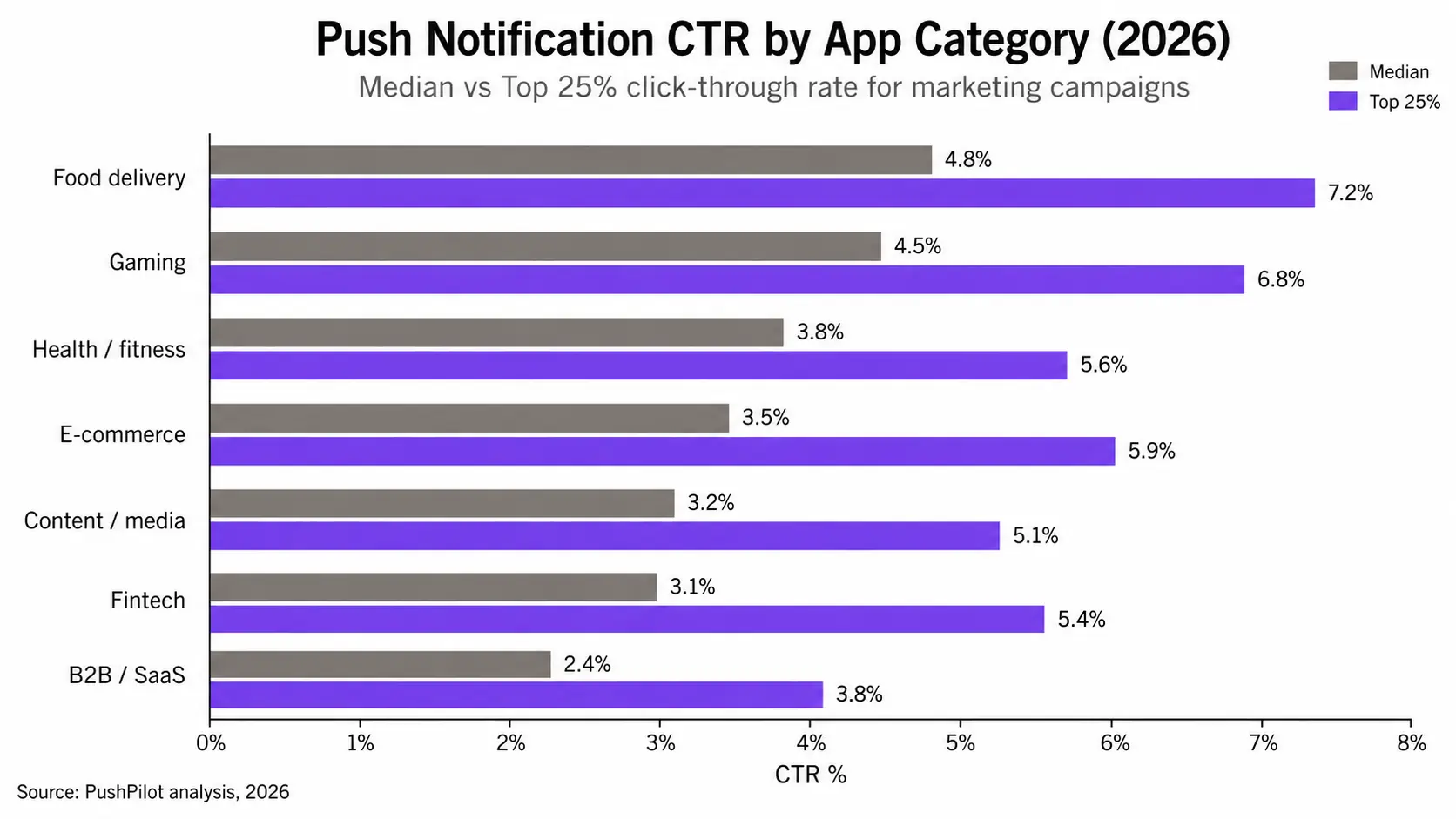
Two things stand out. First, the gap between median and top-quartile is massive in every category. In e-commerce, the top 25% of campaigns get nearly 70% more clicks than the median. That gap is not explained by budget or audience size. It is explained by copy quality, personalization, and timing.
Second, B2B / SaaS consistently lands at the bottom for marketing pushes. This is not a failure of the channel. It reflects a mismatch: most B2B push campaigns are generic product announcements sent to disengaged users. B2B teams that switch to workflow-triggered nudges ("Your report is ready" or "3 tasks due today") see CTR that rivals consumer apps.
Message length: the 70-character cliff
This is the most underrated CTR variable. Teams obsess over timing and A/B testing subject lines, but rarely audit how many of their notifications get truncated on the lock screen.
The data shows a clear cliff. Notifications under 70 characters consistently outperform longer messages, and the drop accelerates past 90 characters where most devices truncate.
| Character Count | Relative CTR | Lock Screen Visibility | Practical Impact |
|---|---|---|---|
| Under 40 characters | Baseline | Full visibility | Can feel too vague, lacks context for a tap |
| 40 to 70 characters | +38% vs 90+ group | Full visibility | Sweet spot: specific, urgent, and fully visible |
| 70 to 90 characters | +12% vs 90+ group | Partial on some devices | Works if the CTA appears before the truncation point |
| Over 90 characters | Baseline (lowest) | Truncated on most devices | CTA hidden, user sees incomplete thought |
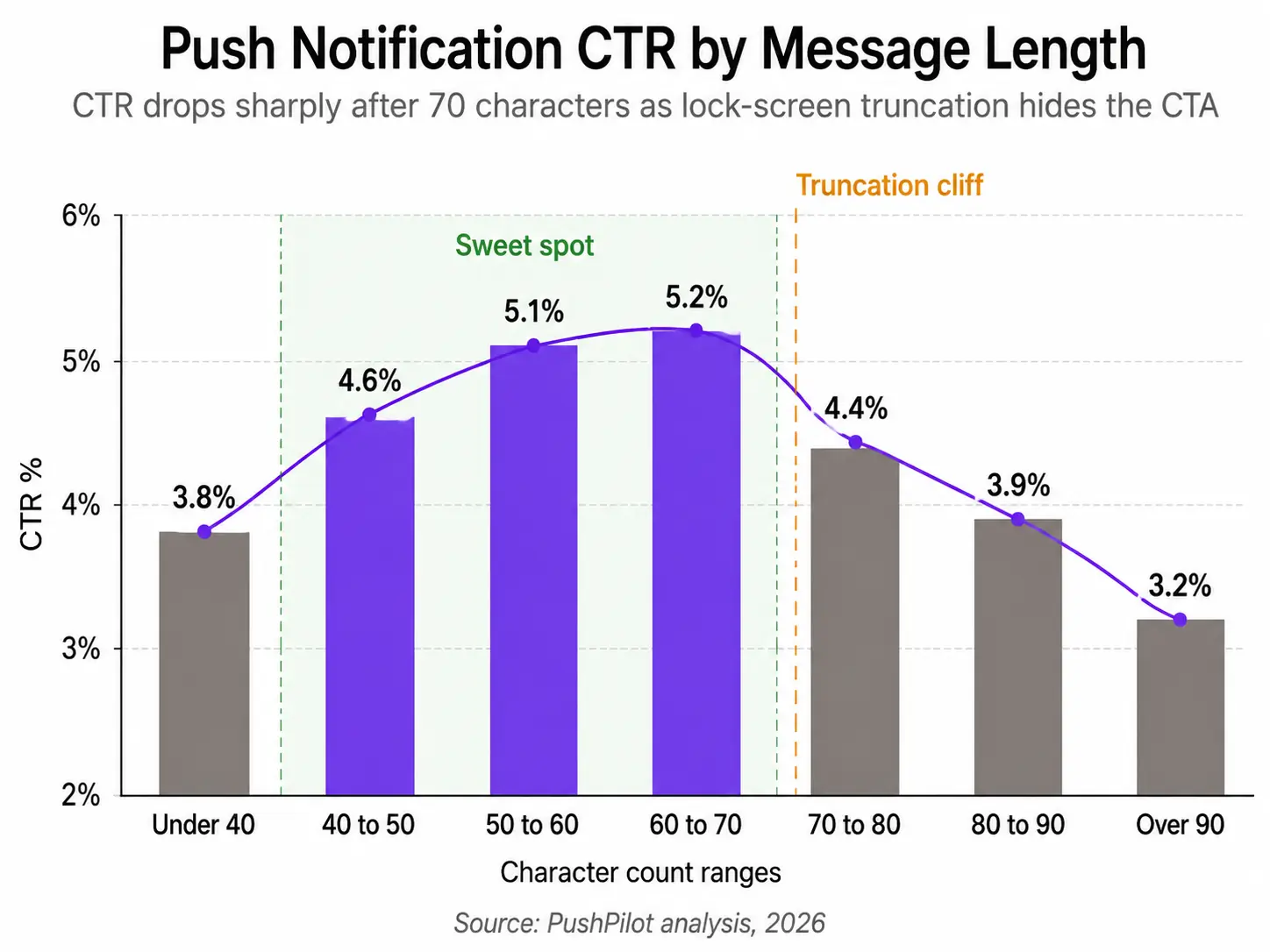
The mechanism is simple. On a locked iPhone, the notification center shows roughly 110 characters including the app name and timestamp. On Android, it varies by manufacturer but typically caps the preview at 65-80 characters for the body text. When the message gets truncated, the user reads half a thought and dismisses it.
Real examples (character counts shown)
62 chars (visible in full)
Your cart expires in 2 hours. Complete checkout for free shipping.
118 chars (truncated on most devices)
We noticed you left some items in your cart! Come back and complete your purchase today to receive free shipping on orders over $50....
The first version tells the user exactly what to do and why, in one visible line. The second buries the value proposition (free shipping) after the truncation point. Same intent. Very different outcome.
Message type matters more than timing
Teams spend weeks optimizing send times while sending the same generic broadcast to everyone. The data shows that message type (what you send) has a larger CTR impact than timing (when you send it).
| Message Type | Average CTR | Why It Works (or Doesn't) |
|---|---|---|
| Urgency-based (flash sale, expiring offer) | 5.8% | Creates immediate loss aversion, clear reason to tap now |
| Personalized recommendation | 5.2% | Relevant to the user's demonstrated interest |
| Social / activity trigger | 4.7% | Leverages social proof and FOMO |
| Streak / progress reminder | 4.3% | Taps into sunk-cost and consistency motivation |
| Content / editorial | 3.4% | Depends heavily on headline quality and topic fit |
| Generic broadcast promotion | 1.8% | No urgency, no personalization, no reason to tap now |
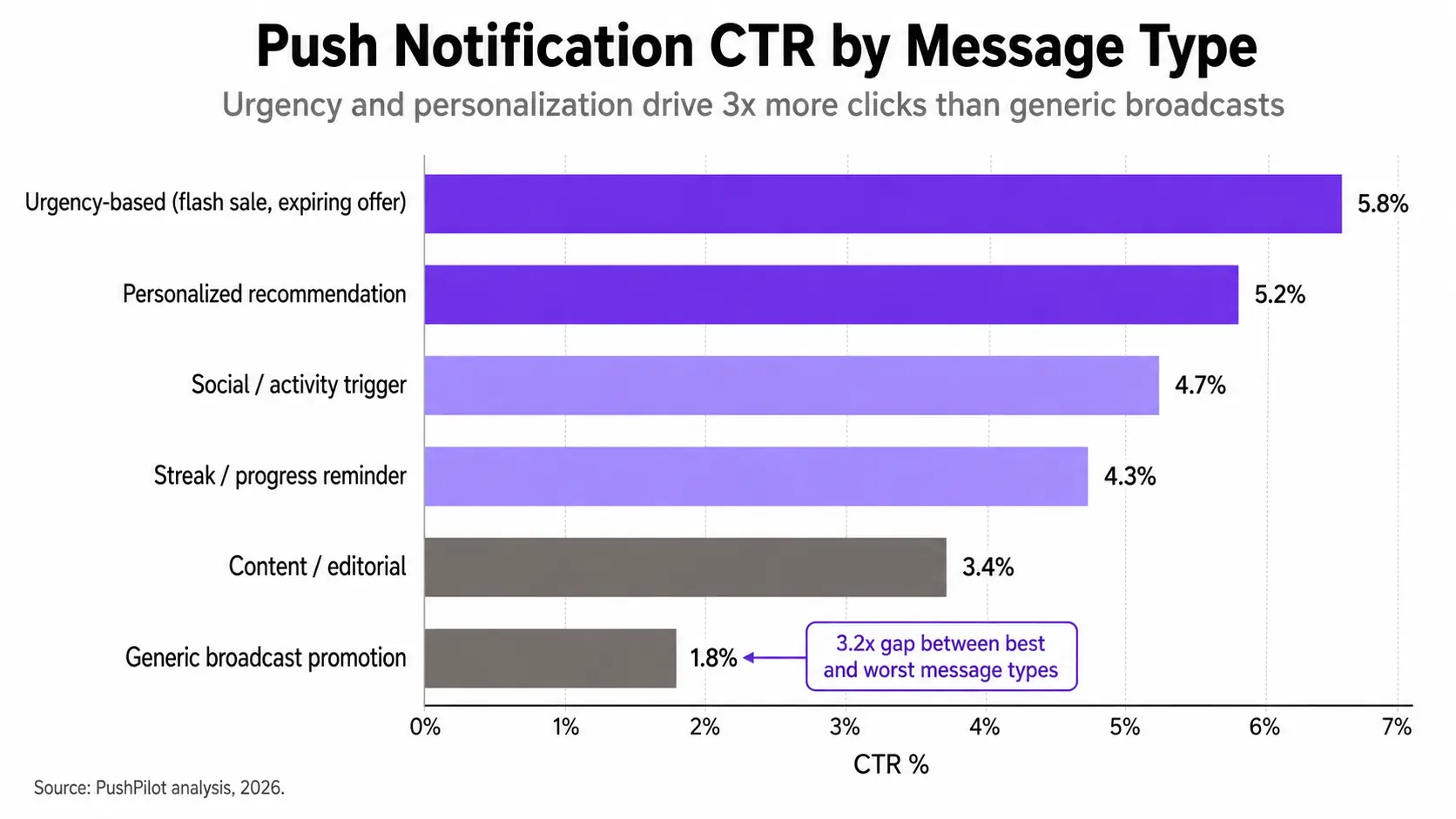
The gap between the top and bottom is striking: urgency-based messages get 3.2x the CTR of generic broadcasts. That is a larger effect than the difference between best and worst send times, which typically ranges from 1.4x to 2x.
The implication: if you are only going to optimize one thing, optimize what you send before when you send it. A mediocre message at the perfect time will underperform a great message at an average time.
AI-generated vs human-written copy
This is the question every push team asks in 2026: can AI write notifications that perform as well as a skilled copywriter? We ran controlled comparisons across PushPilot campaigns where the same audience, same timing, and same targeting received either AI-generated or human-written variants.
| Metric | Human-Written | AI-Generated | Difference |
|---|---|---|---|
| Average CTR | 4.1% | 4.6% | +12% for AI |
| CTR variance (std dev) | 1.8% | 0.9% | AI is 2x more consistent |
| Best single variant CTR | 7.3% | 6.1% | Human ceiling is higher |
| Worst single variant CTR | 0.8% | 2.1% | AI floor is much higher |
| Time to produce 10 variants | 45-90 min | Under 2 min | 30-45x faster production |
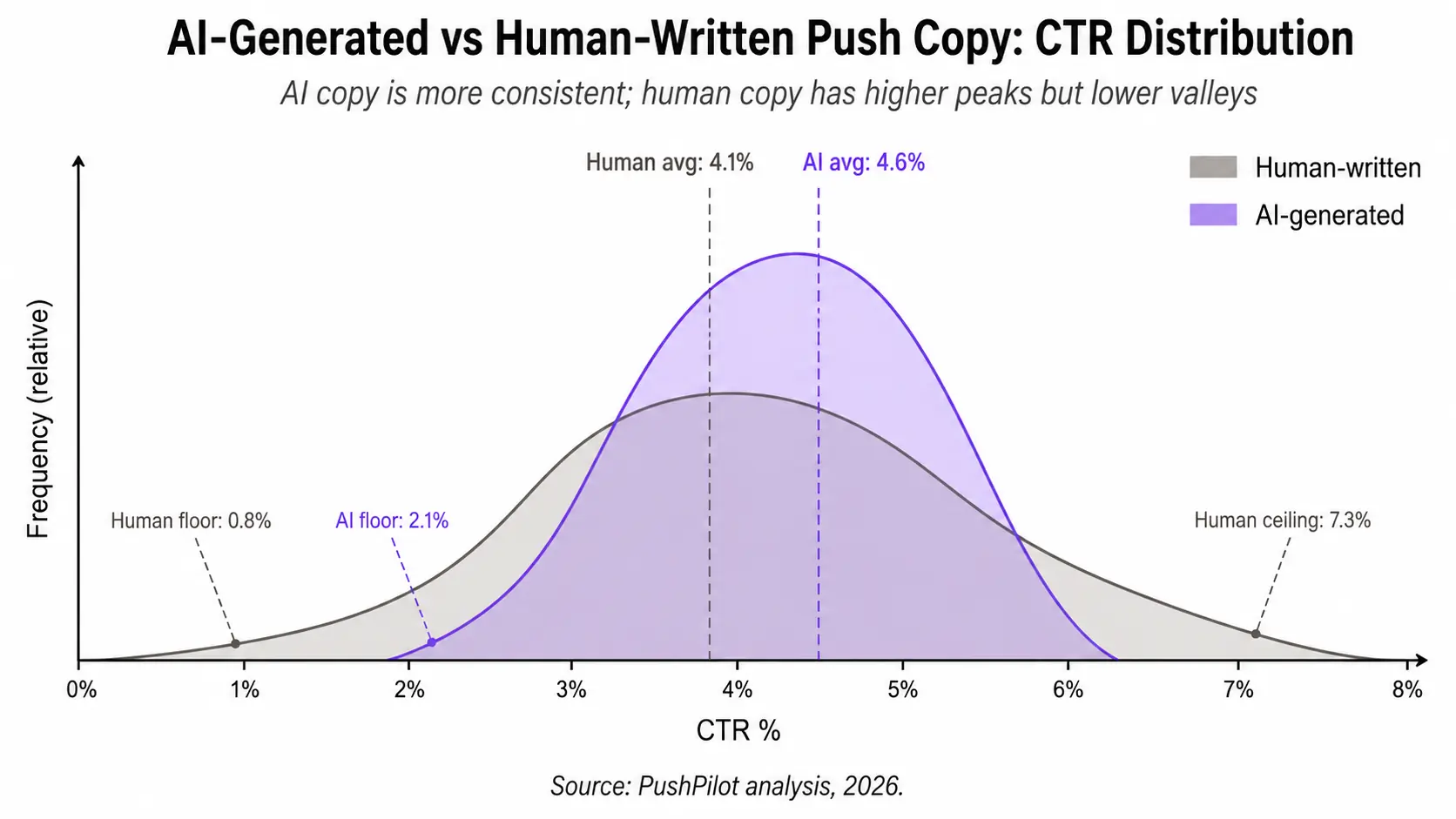
The honest takeaway: a talented human copywriter can still write the single highest-performing notification. The best human variants hit 7%+ CTR, while the best AI variants cap around 6%. But the average human output is worse than the average AI output, and much less consistent.
For most teams, the practical question is not "which ceiling is higher" but "which floor is higher." If you have one exceptional copywriter who dedicates focused time to every push, human copy wins. If you are a team of three trying to run 12 campaigns per week across multiple segments, AI-generated push copy delivers better average outcomes with a fraction of the effort.
Why this matters
Firebase FCM and OneSignal deliver messages reliably. But they leave copy creation entirely to you. PushPilot is an AI push notification platform that generates, tests, and optimizes message variants automatically on top of your existing delivery stack.
Paste your app and see AI-generated push notifications in secondsThe personalization multiplier
Personalization is the most discussed and least implemented CTR lever. Every push notification platform, from OneSignal to Braze to Customer.io, supports dynamic variables. Yet the majority of campaigns we see are still identical messages sent to the entire user base.
The CTR data shows a clear hierarchy of personalization depth:
| Personalization Level | Example | Average CTR | Lift vs Generic |
|---|---|---|---|
| No personalization | "Check out our summer sale!" | 1.8% | Baseline |
| Name only | "Hey Sarah, check out our summer sale!" | 2.6% | +44% |
| Segment-based | "New running shoes starting at $89" (to fitness segment) | 3.9% | +117% |
| Behavior-based | "The Nike Pegasus you viewed is back in stock" | 5.4% | +200% |
| AI-contextual | Dynamic copy + product + timing adapted per user | 7.4% | +311% |
The jump from no personalization to behavior-based is 3x. Going further with AI-contextual personalization (where the message, product reference, and send time are all adapted per user) pushes the multiplier past 4x.
The reason most teams stay at the bottom two tiers is operational: creating hundreds of message variants for different segments and behaviors requires either a large content team or AI-generated push copy. Tools like Braze and Customer.io offer dynamic content blocks. PushPilot generates entire notification variants with AI, which is the approach that scales personalization without scaling headcount.
What kills CTR (the anti-patterns)
High-CTR campaigns share common traits. But low-CTR campaigns share common mistakes. These five anti-patterns appear consistently in the bottom 10% of campaigns by CTR:
1. Sending the same message to everyone
A single broadcast to your entire user base is the fastest way to destroy CTR. Active daily users and users who last opened your app 3 weeks ago need fundamentally different messages. Sending them the same text guarantees it is wrong for most of them.
2. No clear action in the notification
"We have exciting news!" is not a reason to tap. It is a reason to dismiss. Every notification needs to answer "what happens when I tap this?" in the first line. If you cannot describe the payoff in 10 words, the notification is not ready to send.
3. Too many notifications in one day
Apps that send 3+ marketing notifications in a single day see CTR drop by 40-60% on the second and third message. The first notification gets a fair look. Everything after it feels like spam, even if the content is good. Per-user daily caps of 1-2 marketing messages are a non-negotiable guard rail.
4. Sending to users who stopped engaging
Users who have not opened your last 5 notifications should be suppressed from campaigns, at least temporarily. Continuing to send to disengaged users drags down your overall CTR (making it harder to evaluate what is working) and increases your opt-out rate. A 30-day cooldown for consistently unresponsive users protects both your metrics and your relationship with the platform.
5. Ignoring Android notification channels
Android users can selectively disable notification categories. If all your messages come through one channel, a user who disables it goes silent forever. Splitting into logical channels (promotions, updates, alerts) lets users opt out of what they do not want while keeping the channels they value. Most push notification platforms including OneSignal and Firebase FCM support this natively.
A CTR improvement playbook
If you are starting from a baseline CTR under 3%, these five changes, in this order, will produce the largest lift with the least effort:
- Audit your message length and cut everything over 70 characters. Rewrite truncated notifications to front-load the action and value proposition. This is a one-time effort that immediately lifts CTR for every future send.
- Suppress disengaged users from campaign sends. Users who have not opened any of your last 5 notifications should not receive the next one. This raises your measured CTR and prevents further damage to the relationship.
- Replace at least one generic broadcast per week with a behavior-triggered message. Start with the easiest trigger: abandoned action (cart, session, content). This single change often doubles the CTR of that send slot.
- A/B test urgency framing against neutral framing. For the same offer, compare "Ends tonight" vs "Now available." Urgency framing consistently wins by 30-60%, but the exact magnitude varies by audience.
- Try AI-generated variants against your current copy. Run a 50/50 split for 2 weeks. If AI matches or beats human copy (as it does for most teams), you have unlocked the ability to produce personalized variants at scale without adding headcount.
The 5-Step CTR Framework: shorten copy, suppress disengaged users, trigger on behavior, frame with urgency, and test AI variants. Each step compounds on the previous one.
FAQ
What is a good push notification CTR in 2026?
The median CTR across consumer apps sits between 3.1% and 4.2% depending on category. E-commerce and food delivery typically land near 3.5%, while fintech and gaming can exceed 5%. Any CTR consistently above 5% indicates strong message-audience fit. Below 2% usually signals content or timing problems worth investigating.
Does message length affect push notification click-through rate?
Yes. Notifications between 40 and 70 characters consistently outperform both shorter and longer copy. Under 40 characters often lacks enough context to justify a tap. Over 90 characters gets truncated on most Android and iOS lock screens, which hides the call to action. The sweet spot is a specific, urgent sentence that fits in one visible line.
Do AI-generated push notifications get higher CTR than human-written ones?
In controlled tests, AI-generated push copy matches or slightly beats human-written copy on average CTR (4.6% vs 4.1% in PushPilot campaign data). The bigger advantage is consistency and scale: AI maintains quality across hundreds of variants while human writers show more variance. Human copy still wins for brand voice and humor-driven campaigns.
Which push notification category gets the highest CTR?
Transactional alerts (order updates, payment confirmations) consistently get the highest open rates at 8-12%, but those are not comparable to marketing campaigns. Among marketing pushes, urgency-based messages (flash sales, expiring offers) lead at 5-7%, followed by personalized recommendations at 4-6%. Generic broadcast promotions sit at 2-3%.
How do I improve push notification CTR without sending more?
Focus on three high-leverage changes: shorten copy to under 70 characters with a clear action hook, localize send times to user timezones, and replace generic broadcasts with behavior-triggered messages. These three changes typically lift CTR by 30-60% without increasing send volume. AI push notification software like PushPilot automates all three.
Bottom line
Push notification CTR is not random. It is driven by a small number of controllable variables: message length, personalization depth, message type, and copy quality. Timing matters, but less than most teams assume.
The highest-impact changes are also the simplest: cut message length, suppress disengaged users, and move from generic broadcasts to behavior-triggered sends. Teams that combine these fundamentals with AI-generated push copy consistently land in the top quartile of their category.
The tools exist. Firebase FCM and OneSignal handle delivery. Braze, Customer.io, and CleverTap offer orchestration. PushPilot sits at the AI campaign intelligence layer, generating copy and optimizing sends so your team focuses on strategy instead of writing push notification variants by hand.
See what AI-optimized push looks like for your app
PushPilot generates high-CTR push notification variants with AI, on top of your existing Firebase FCM or OneSignal setup. No migration, no SDK changes.
Paste your app and see AI-generated push notifications in secondsData references: Braze Global Customer Engagement Review 2025, CleverTap Push Notification Benchmark Report, Airship Mobile App Experience Benchmark, OneSignal State of Customer Messaging 2025, and aggregated PushPilot campaign analytics from 2025-2026. Individual app results will vary based on audience composition, content quality, and platform delivery infrastructure.