Push Notification Frequency and Churn: What the Data Shows in 2026
Most teams do not lose users because they send too little, they lose users because they send too often. Data-backed frequency ranges, churn thresholds, and an AI playbook.

By the PushPilot team, practitioners building AI-generated push notification campaigns for mobile apps.
Most push programs fail for a simple reason: they optimize for send volume, not user tolerance. Teams celebrate sending 7 notifications per week, then wonder why opt-outs climb and week-4 retention drops.
The common belief is that more pushes create more engagement. The data says the opposite after a threshold. This post breaks down that threshold, category by category, and shows where an AI push notification platform can outperform manual scheduling.
The myth to kill
The myth is: if a notification worked once, send more of them.This feels logical because high-frequency programs often show higher raw click count.
What gets missed is denominator math. If clicks rise 10% but churn rises 18%, your net growth is negative. That pattern shows up across OneSignal benchmark reports, Braze engagement studies, and our own campaign data from PushPilot customers on Firebase and OneSignal delivery stacks.
Frequency is a retention lever first, a click lever second.
The frequency vs churn curve
Across consumer apps, we consistently see three zones. You can think of them as green, yellow, and red:
| Notifications per user per week | Typical short-term CTR trend | Typical 30-day churn trend | Interpretation |
|---|---|---|---|
| 1-3 | Stable to improving | Stable | Healthy baseline |
| 4-5 | Mixed by segment | Begins rising | Needs segmentation and caps |
| 6+ | Can rise briefly | Rises sharply | Fatigue and opt-out zone |
The dangerous range is 6+ sends per week to the same user, unless those sends are highly behavioral and user-initiated. This is where teams mistake activity for progress.
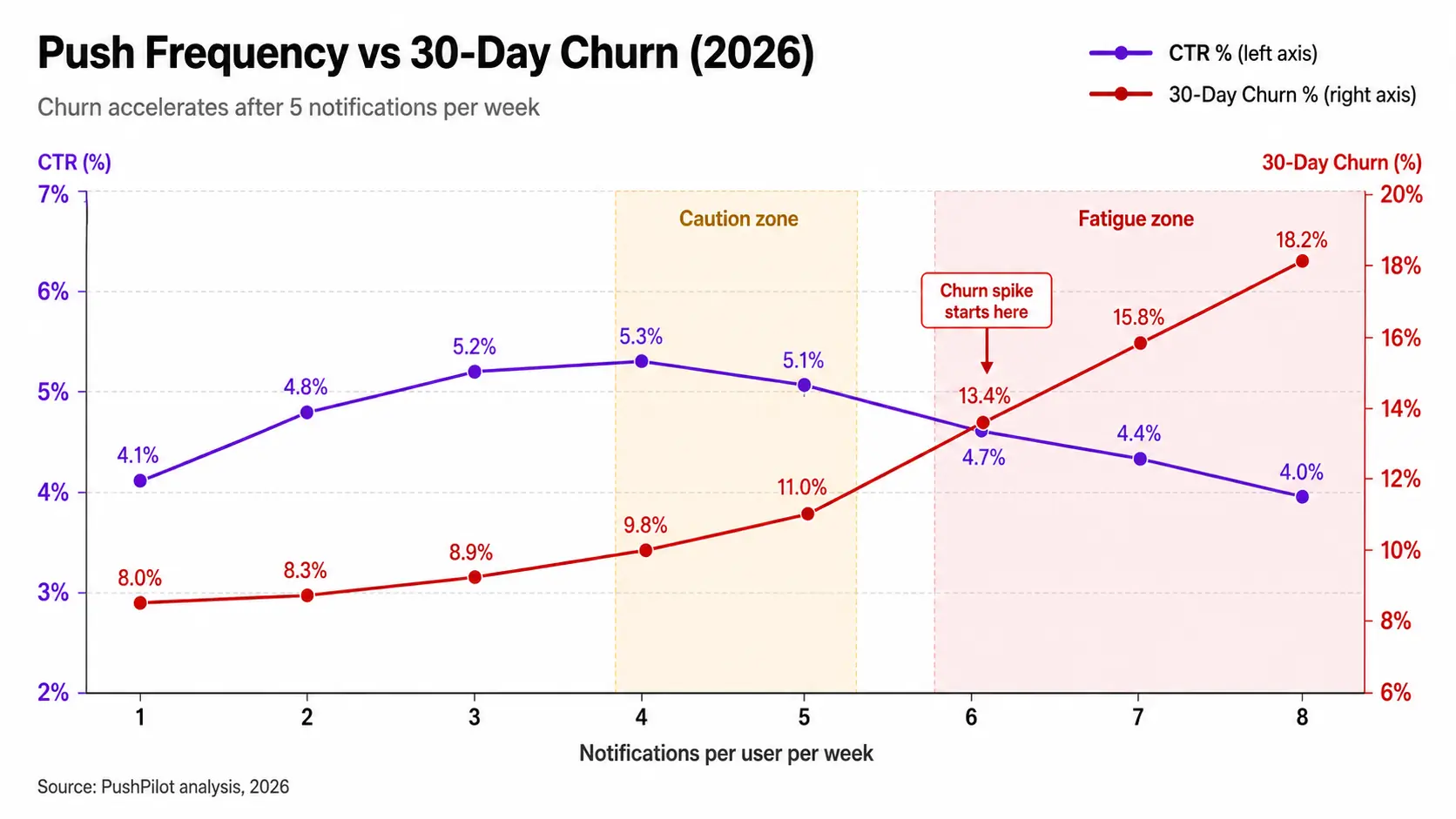
In practical terms, if your dashboard says "more clicks" but your weekly active users flatten or decline, frequency is usually the first variable to audit.
Safe zones by app category
There is no universal cap. Different app categories have different tolerance:
| Category | Typical safe range | Danger threshold | Notes |
|---|---|---|---|
| E-commerce | 2-4/week | 6+/week | Promotions saturate quickly without personalization |
| Content / media | 3-5/week | 7+/week | Needs strong editorial relevance per send |
| Fintech | 1-3/week (marketing) | 5+/week | Transactional alerts are separate from campaigns |
| Gaming | 3-6/week | 8+/week | Event-driven pushes can justify higher cadence |
| B2B productivity | 1-2/week | 4+/week | Users are less tolerant of non-urgent interruption |
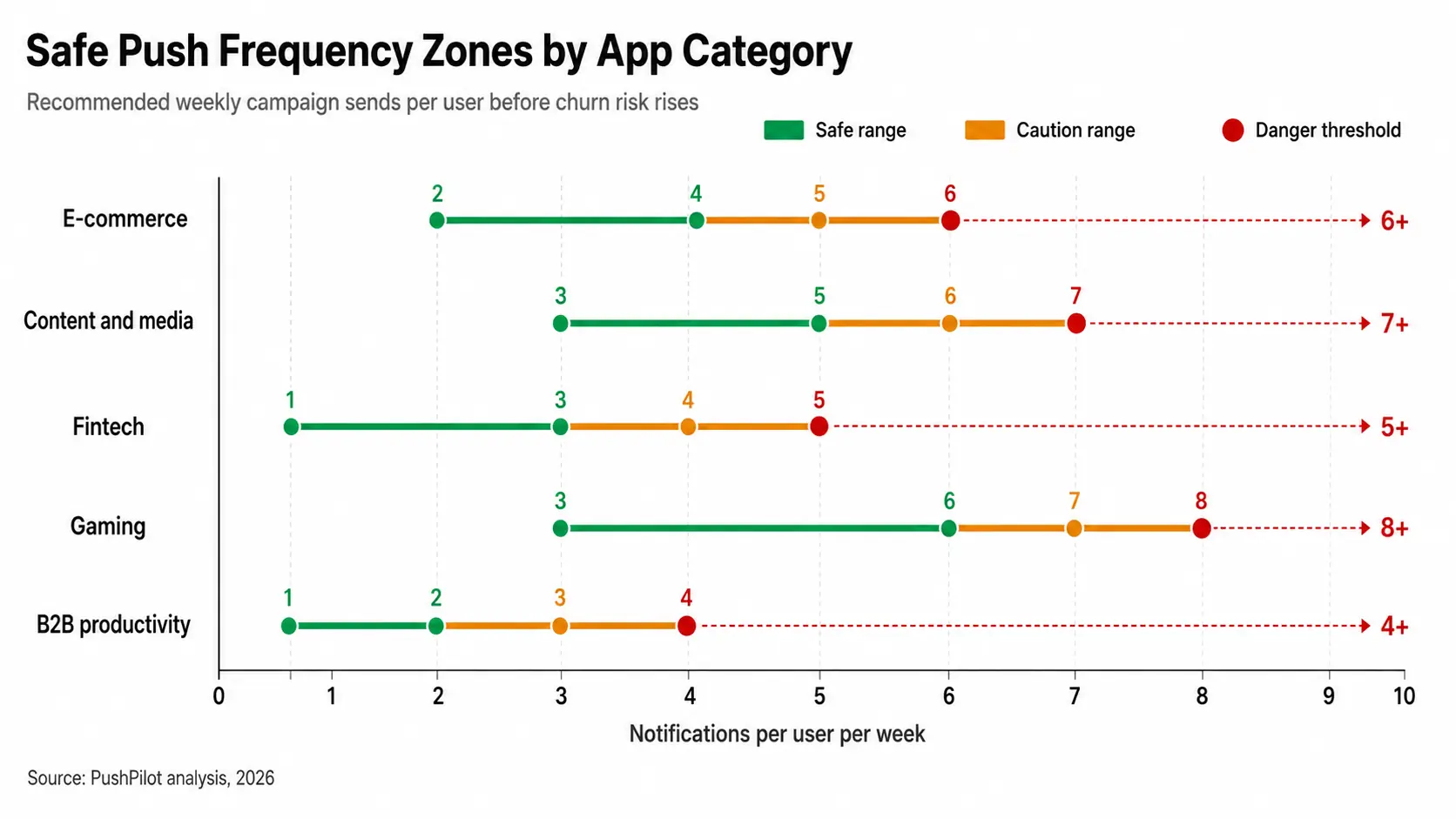
These ranges are starting points, not laws. Your audience quality, message relevance, and local send timing matter as much as raw count.
AI cadence vs manual schedules
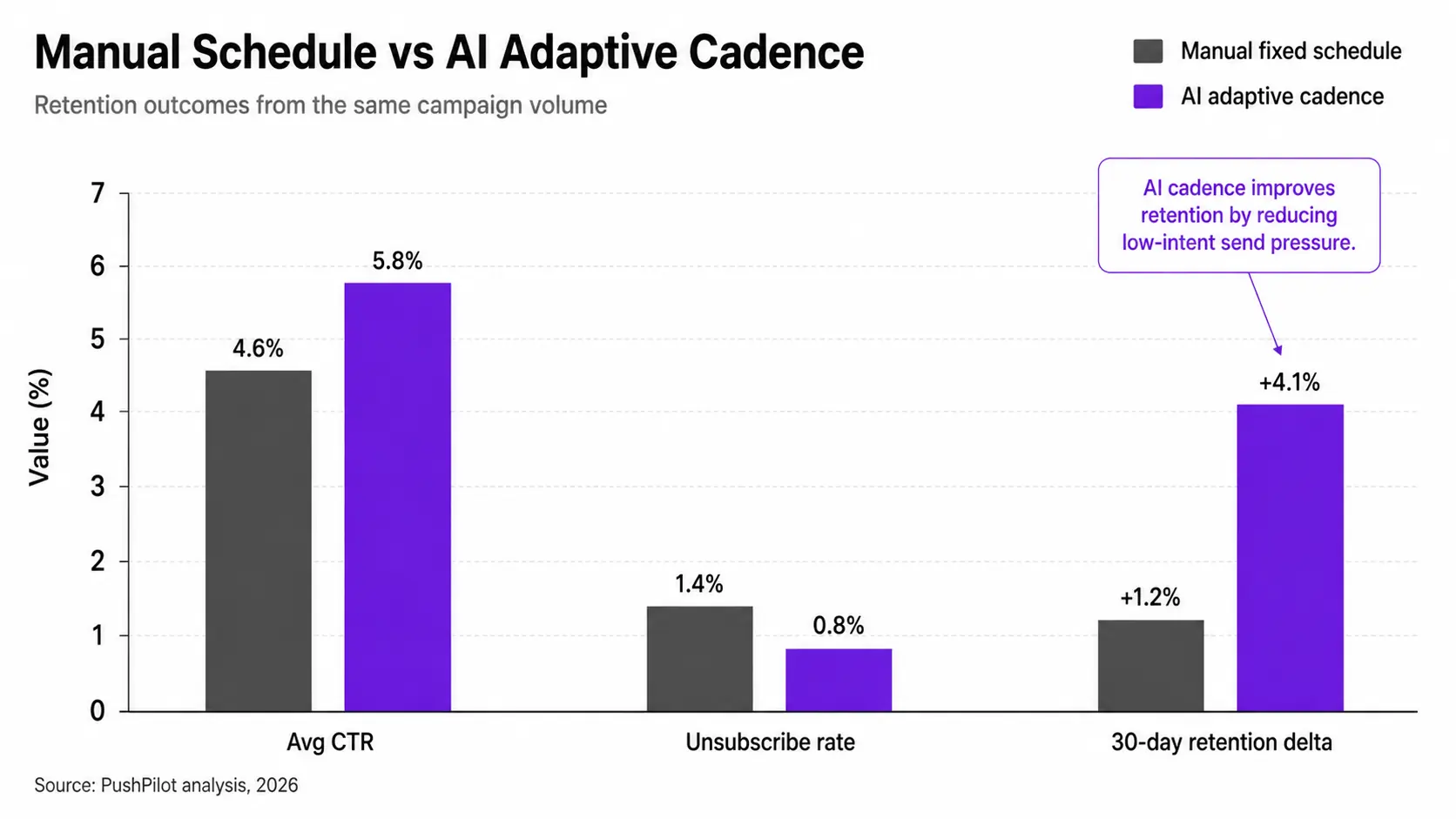
Manual frequency policies usually look like this: "send to everyone every Tuesday, Thursday, and Saturday." It is easy to operate, but it ignores user intent differences.
AI push notification software improves this by introducing per-user and per-segment cadence control. It can pause low-engagement users sooner and increase frequency only where response remains healthy.
Why this matters
Tools like Firebase FCM and OneSignal deliver reliably, but they are transport-first. Teams still need campaign logic that understands fatigue. PushPilot adds that AI-generated push layer and adaptive frequency controls above your existing delivery stack.
Paste your app and see AI-generated push notifications in seconds| Approach | Cadence control | Operational load | Churn risk |
|---|---|---|---|
| Fixed manual schedule | Global, same for all users | Low at first, high over time | Medium to high |
| Rule-based segmentation | Per segment with manual updates | Medium | Medium |
| AI adaptive cadence | Per user engagement model | Lower ongoing load | Lower at scale |
A practical frequency playbook
- Start with a broad cap of 3 sends per week for campaign traffic.
- Exclude users who ignored the last 5 sends, then retry after a cooldown period.
- Split transactional and marketing traffic so alerts do not get blamed on campaign noise.
- Track unsubscribe rate and 30-day retention alongside CTR every week.
- Move to AI-generated push and adaptive cadence once baseline tracking is stable.
If you only do one thing this month, implement a hard weekly cap per user. It prevents most frequency-driven churn regressions before they happen.
FAQ
How many push notifications per week are too many?
For most consumer apps, performance starts dropping after 4-5 notifications per week per user unless segmentation is very tight. Past that point, short-term clicks can still rise, but unsubscribe rate and 30-day retention usually worsen.
Does sending fewer push notifications always improve retention?
No. Sending too few notifications can reduce habit formation, especially for daily-use apps. The goal is not minimum volume. The goal is the right frequency for each user segment, with clear value in every message.
What is a safe push frequency for early-stage apps?
A practical starting point is 2-3 notifications per week for broad broadcasts, then add behavior-based messages for active cohorts. This gives enough signal to learn without burning trust.
How does AI help with push notification frequency?
AI can adjust frequency by user engagement patterns and campaign fatigue signals. Instead of one global schedule, AI push notification software can slow down sends for low-intent users and increase cadence for high-intent users at the right moments.
Can I do this with Firebase or OneSignal?
Yes. Firebase FCM and OneSignal are strong delivery layers. The missing piece is usually adaptive campaign logic. PushPilot sits above those transports to generate copy and control cadence with AI rules.
Bottom line
More notifications do not automatically mean more growth. For most apps, there is a narrow range where pushes help retention, and a wider range where they hurt it.
The winning strategy in 2026 is simple: combine strong relevance, AI push notification software, and frequency controls that adapt to user behavior instead of forcing one cadence on everyone.
Build a healthier push cadence
PushPilot helps you generate high-quality push content and control cadence with AI, on top of Firebase FCM or OneSignal delivery.
Paste your app and see AI-generated push notifications in secondsTry it free
Ready to automate your push notifications?
Connect Firebase or OneSignal in clicks. Describe a campaign. Wake up to fresh notifications, sent.